Hi friends,
Today I want to show a small history, of Betxi.
All Spain is occupied to motogp races, the engine and motorcycle tuning is a dream for the people in your garage home. Electronic, sponsors, TV camera and always the same, the same races, the same comments.......
All Spain is occupied?? No, Betxi is a small village near Mediterranean sea on every year run the red bull cultivator races. Is it a sidecar? Is it a motorcycle ?? No no no...... It's a agricultural machines with a good engine tuning and good cycle tuning with two persons up on the machine.
Please I invite to see a video.
https://vimeo.com/168607453
Thanks for visit my blog
sábado, 11 de junio de 2016

miércoles, 18 de mayo de 2016
TT 2016 table times and promotional video
Hi friends,
TT 2016 is here, The link is to see a 2016 promotional video of race. This is a true motogp races, true races.
https://www.youtube.com/watch?v=4Obaec_aJfE
TT 2016 is here, The link is to see a 2016 promotional video of race. This is a true motogp races, true races.
https://www.youtube.com/watch?v=4Obaec_aJfE
Saturday 28 may
18.20 – Newcomers only (Rookies) speed controled
18.25 – Sidecar (Rookies) speed controled
18.40 – Lightweight & Supersport +Rookies all categories
18.25 – Sidecar (Rookies) speed controled
18.40 – Lightweight & Supersport +Rookies all categories
monday 30 may
18.20 -19.50 – Superbike/ Superstock/ Supersport + Rookies
19.55 – 20.50 – Sidecars
19.55 – 20.50 – Sidecars
Tuesday 31 may
18.20 – 19.25 – Superbike/ Superstock/ Supersport
19.25 – 19.55 – Lightweight & Supersport +Rookies all categories
20.00 – Sidecars
19.25 – 19.55 – Lightweight & Supersport +Rookies all categories
20.00 – Sidecars
Wednesday 1 de june
18.20 – 19.50 – Superbike/ Superstock/ Supersport
19.55 – 20.50 – Sidecars
19.55 – 20.50 – Sidecars
Thursday 2 june
18.20 – 19.25 – Superbike/Superstock/Supersport
19.25 – 19.55 – Lightweight & Supersport +Newcomers all categories
20.00 – Sidecars
19.25 – 19.55 – Lightweight & Supersport +Newcomers all categories
20.00 – Sidecars
Friday 3 june
18.20 – 19.45 – Superbike/Superstock/Supersport
19.50 – 20.35 – Sidecars
20.40 – TT Zero only 1 lap for clasification
19.50 – 20.35 – Sidecars
20.40 – TT Zero only 1 lap for clasification
Saturday 4 june
11.00 – RST Superbike TT Carrera(6 laps)
14.00 – Sure Sidecar TT Firts race ( 3 laps)
15.30 – Superstock/ Supersport/ Lightweight (2laps)
14.00 – Sure Sidecar TT Firts race ( 3 laps)
15.30 – Superstock/ Supersport/ Lightweight (2laps)
Monday 6 june
10.45 – Monster Energy Supersport TT Primera carrera(4 laps)
12.25 – Sidecar calificación(2 laps)
14.15 – RL360 Superstock TT Race (4 laps)
16.05 – Lightweight calificación(1 lap)
16.25 – TT Zero calificación(l lap)
12.25 – Sidecar calificación(2 laps)
14.15 – RL360 Superstock TT Race (4 laps)
16.05 – Lightweight calificación(1 lap)
16.25 – TT Zero calificación(l lap)
Wednesday 8 june
10.45 – Monster Energy Supersport TT Second race (4 laps)
12.25 – Sidecar calificación(1 lap)
14.00 – Bennetts Lightweight TT Race (4 laps)
15.45 – Senior TT calification (1 lap)
16.20 – TT Zero Race (1 lap)
12.25 – Sidecar calificación(1 lap)
14.00 – Bennetts Lightweight TT Race (4 laps)
15.45 – Senior TT calification (1 lap)
16.20 – TT Zero Race (1 lap)
Friday 10 Junio
10.15 – Sure Sidecar TT Second race (3 laps)
12.30 – PokerStars Senior TT Race (6 laps)
12.30 – PokerStars Senior TT Race (6 laps)
Thanks to visit my blog
martes, 3 de mayo de 2016
TT IOM information for all
Hi friends
this is a blog of Jean Michel Prudon, he has not blood on your body , he has a TT air , He eats all TT wolrd.
http://www.tourist-trophy.fr/
If you want to know TT universy, visit a Jean Michel blog.
Thanks for visit my blog.
this is a blog of Jean Michel Prudon, he has not blood on your body , he has a TT air , He eats all TT wolrd.
http://www.tourist-trophy.fr/
If you want to know TT universy, visit a Jean Michel blog.
Thanks for visit my blog.
sábado, 16 de abril de 2016
Lambretta moped racing II


domingo, 10 de abril de 2016
CBR F2 RACING SOLO SEAT
Hi friends
A few time
ago I buyed a racing solo seat for my CBR F2 ,this is a works for mounting in a
bike. An original CBR F2 model is this.

The first step is dismount parts of an original seat.Is neccesary clean all parts
and cut rear tail lights......
In the next image is possible to see a new metal suport for solo
seat. Is necessary because this new solo seat is only fibercomposite. The new suport
has a bolts in near gas tank and in old original seat. Is not necessary get hole in
frame.

For this new solo seat is necessary take off the rear footrest.
And the next image is rear part after cut of the frame.


Is neccessary change CDI ubication too,
the solution is on frame rear center in a one hole of frame.


And the nex timage is put on bike the racing solo seat
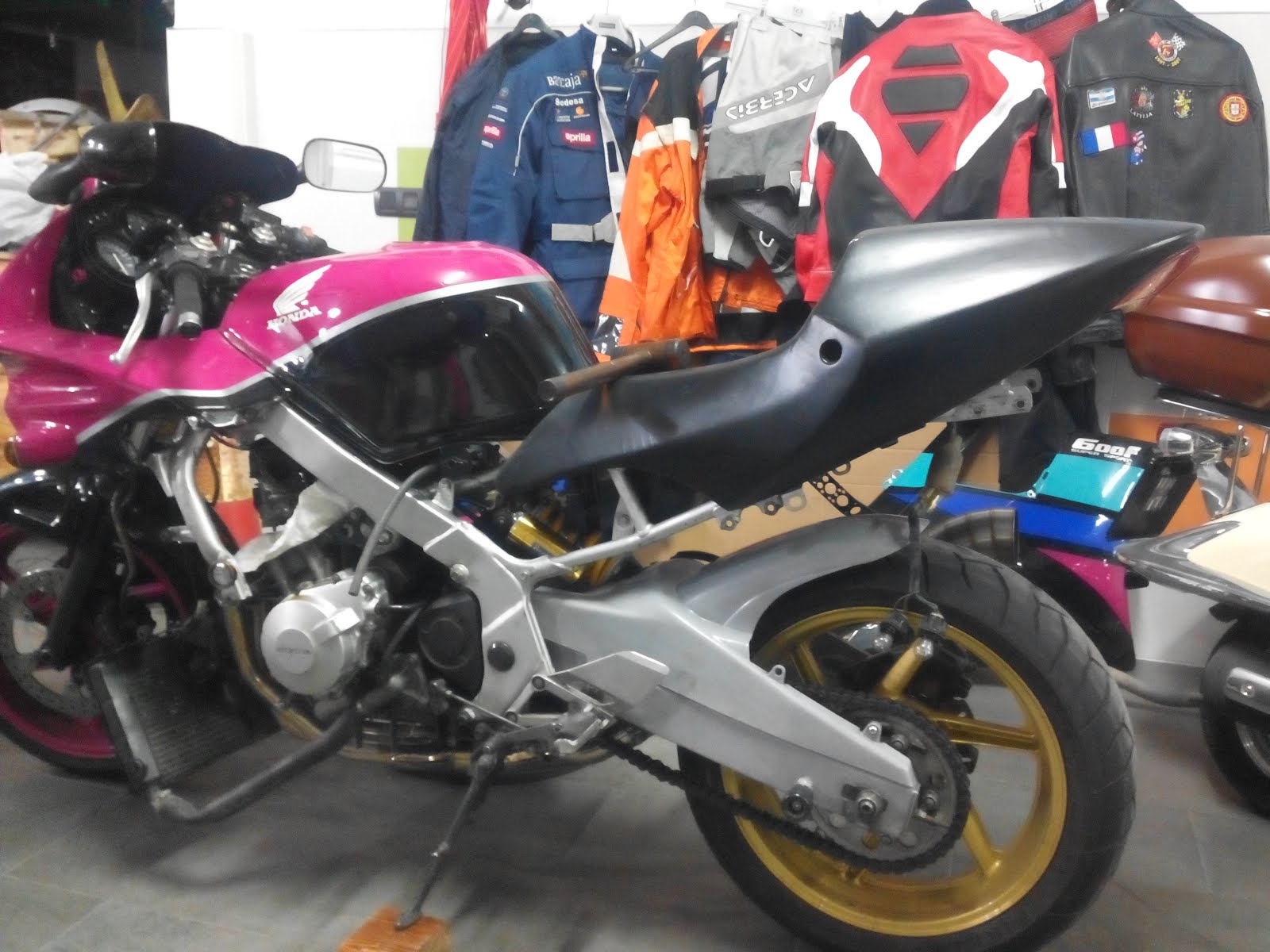
And continue....................
Thnaks for visit my blog..............
domingo, 27 de marzo de 2016
MATHEMATICAL MASTER CLASS YAMAHA TZ R1
Hi friends,
Today I
want to show an old project of mule motorcycles( see http://www.mulemotorcycles.net/ ) is an important mathematical class. This is
a problem: if we take a Yamaha R1 2004 engine, you must to eliminate all parts to
street legal.
Is necessary to bluid a new frame copy of Tz 750 (the beast)
but with new cotes for R1 engine.
Buy a old 18” Harley rims, Ohlins parts to front and rear and
Brembo parts to stop this machine.
Result: More than180 CV, less 170 Kg Horsepower /weight relation is more than 1!!!!!
Richard Pollock from mule motorcycles, know this wolrd, good work
See an images, please


Source: Voromv and todocircuito
domingo, 20 de marzo de 2016
ANTONIO COBAS

Antonio Cobas
was an advanced motorcycle designer and engineer long before he decided to
design his own trials bike. Antonio had previously designed and
constructed the European Championship winning 250cc roadracemotorcycles
of Carlos Cardus. In fact Carlos rode the JJ Cobas motorcycle both in 1984 and
1985.He left his career best results for 1990 when he was 2nd in
the World riding the mighty Repsol Honda.
Antonio Cobas is als oresponsible for creating the modern aluminium beam frame roadbikes ,that are common place today. One of the first modern beam frame motorcycles was the Yamaha YPVS EXUP. It is difficult to imagine motorcycles today without the influence of Cobas.
It is generally accepted that Yamaha used the 80's designed Kobas 250cc race bikes as a starting point when they first designed the Delta box frame. Look at the similarities


2007 Yamaha YZF
An original Kobas MR1 chassis JJ Cobos
So
,after appreciating Antonio's achievements and this influence to is hard to think of
anyonewithintheworld of trialswho has had more of aninfluenceontheWorld of
motorcycle in general.
Cobos wasborn in Barcelona onAprilthe 14th 1952. Cobos as a youngmanwaspassionateaboutmotorcycle and alsoengineering. The 1980's broughtmassivelyrefined ,developed and increasedengine performance and improvedtyredesign. Handlingwas a "black art", somethingeveryonewanted to improvebutanareathebike-makerscouldnever quite makegoodenough.
So, whathappened? Progress in frames, suspension, and tires changedthelandscape. Aftertheearly '70s, tire developmentmeantthatstickier tires withincreasingly more gripcame to racing. Long-travelrearsuspensionunitsreplacedtheawful short-stroketwin shocks fromthe era legendarymechanicNobby Clarke describedbestwhen he said, "Suspensionwasjust a word." Forks became more refined, precisioninstruments.
In themid-to-late '70s, frameswherestillinfluencedfromtheearlierdayswhendesignersstrived to put as muchweight to therear as possible in order to gettractionfortherearwheel. McCandless' "Featherbed" framehadfound a sweet spot withits 50/50 weight ratio, and properrearsuspensions and better tires solvedmuch of thetractionissue. Nextthedesignerstried to movetheweight forward -- whereitistoday -- in a bid to getthefrontend to handlebetter.
Theconventionaltubeframewasnow a weakpoint, as theframesonracebikesoftenbegan to crack underthestrongerloads. Thesolution? Braces and extra weldsbecamethemarks of a "real" racebike.
In 1982, Cobas developed a stronger and lighteraluminumtwin-beamchassis to replacethesteelbackboneframes.Thetechnologywascopiedbymajormotorcyclemanufacturers and bythe 1990s, allthemajorracingteams in Grand Prix competitionusedthealuminumframedesignpioneeredby Cobas.
In 1978 Cobos begancreatingmotorcycleswiththemodelname of Siroko's.Theseweresuccessful in theSpanishroadracenationalChampionship.


In 1982
Antonio created the Kobas brand of motorcycles designing his own chassis powered by the
popular Rotax engines. They had great success with riders Sito Pons and Carlos
Cardus.
His chassis designs rocked the motorcycle world
His chassis designs rocked the motorcycle world


The trade mark Kobas rear suspension gives
full rising rate and offers compact installation at the expense of raising the
centre of gravity


Cobas'scontributions
1 - Position ing the rider over the front wheel increasing front tyre grip to rear at a rate of 55/45 when at the time the supposed ideal set up was 50/50.
2 - Compacted the bikes mass and juxtaposed the centre of mass and centre of gravity to reduce the polar movement and improve handling.
3 - Raised the centre of gravity to improve weigh ttransference for improved braking and extra tractionexiting a corner and increased rear suspension travel.
4- Rising rate linkage.
All these featured became common place on Gprace bikes but it was Cobas in theKobaswhofirstpointedtheway. A milestone in modern GP design.


When Pons moved to the Honda factory racing team in 1986, Cobas followed and served as Pons' crewchief. Pons retired as a competitor in 1991 and created the Pons Racing team, naming Cobas as Technical Director. In this role, he prepared motorcycles ridden to Grand Prix victoriesby Alberto Puig and Carlos Checa. He also rejoined Crivillé duringhisworldchampionshipwinningyear in 1999. He also worked closely with Max Biaggi. When he fell ill last year and could not travel to the races, he s till consulted with the team via e-mail.
1 - Position ing the rider over the front wheel increasing front tyre grip to rear at a rate of 55/45 when at the time the supposed ideal set up was 50/50.
2 - Compacted the bikes mass and juxtaposed the centre of mass and centre of gravity to reduce the polar movement and improve handling.
3 - Raised the centre of gravity to improve weigh ttransference for improved braking and extra tractionexiting a corner and increased rear suspension travel.
4- Rising rate linkage.
All these featured became common place on Gprace bikes but it was Cobas in theKobaswhofirstpointedtheway. A milestone in modern GP design.
JJcobas was created in 1983
In 1983, Cobas formed a new
motorcycle company named JJ Cobas. Pons wouldride a JJ Cobas motorcycle in the
1984 250cc worldchampion ship, garneringtheirfirst Grand Prix victorywith a
win at the 1984 Spanish Grand Prix and, endedtheseason in fourth place in
thechampionship.Even greater success came in 1989 when a
Cobas-designed motorcycle ridden by Alex Criville won the 125cc
world championship.
In 1988 JJ Cobos manufactured a very small number of theseroadbikes JY4 for sale to thepublic. The cost washigh at 1,450,000 pesetas and the project was stopped after 2 batches. Most of the bikes were exported to Japan.
In 1988 JJ Cobos manufactured a very small number of theseroadbikes JY4 for sale to thepublic. The cost washigh at 1,450,000 pesetas and the project was stopped after 2 batches. Most of the bikes were exported to Japan.


When Pons moved to the Honda factory racing team in 1986, Cobas followed and served as Pons' crewchief. Pons retired as a competitor in 1991 and created the Pons Racing team, naming Cobas as Technical Director. In this role, he prepared motorcycles ridden to Grand Prix victoriesby Alberto Puig and Carlos Checa. He also rejoined Crivillé duringhisworldchampionshipwinningyear in 1999. He also worked closely with Max Biaggi. When he fell ill last year and could not travel to the races, he s till consulted with the team via e-mail.
Cobos
also worked with the Camel Grand Prix team

Cobas died in 2004 at theage
of 52.
You are very unlikely to come acrossany of Cobos'screatings. Therewereneverany 'customer' Kobas/Cobas framesmadetheywereallforworksriders, whatdidn'tgetcrashedgotsold and crashedbysomeoneelse. There are only a feworiginalsleftone in the US and 10 in Europe(mostly in Spain). Therewas 5 copies made of the US bike and 3 of thosemadeit to Australia.
Camel Pons owner Sito Pons said this about Cobas: "He was indeed a precursor, onewhoopened up thewayforresearch and development, especially in thefield of framedesign, that others then followed."
Pons - "A top-level engineer, alwaysperfectlyaware of theavailabletechnology and always knowing exactlywhat to do to enterthefuture,"
"He was always two orthre estep sahead of the others."
Suscribirse a:
Entradas (Atom)